Development Operations Harness Framework
2026-04-01 — present
Git-based personal harness for reproducible development operations and resume/JD curation — integrating local BGE-M3 RAG, MCP search, Git-hook quality gates, JD-custom PDF generation, Zighang external feedback loops, and safe T1/T2/T3 application gates
System Architecture
Problem Solving
Development-runtime context and rules drifted across docs, config, and local runtime homes
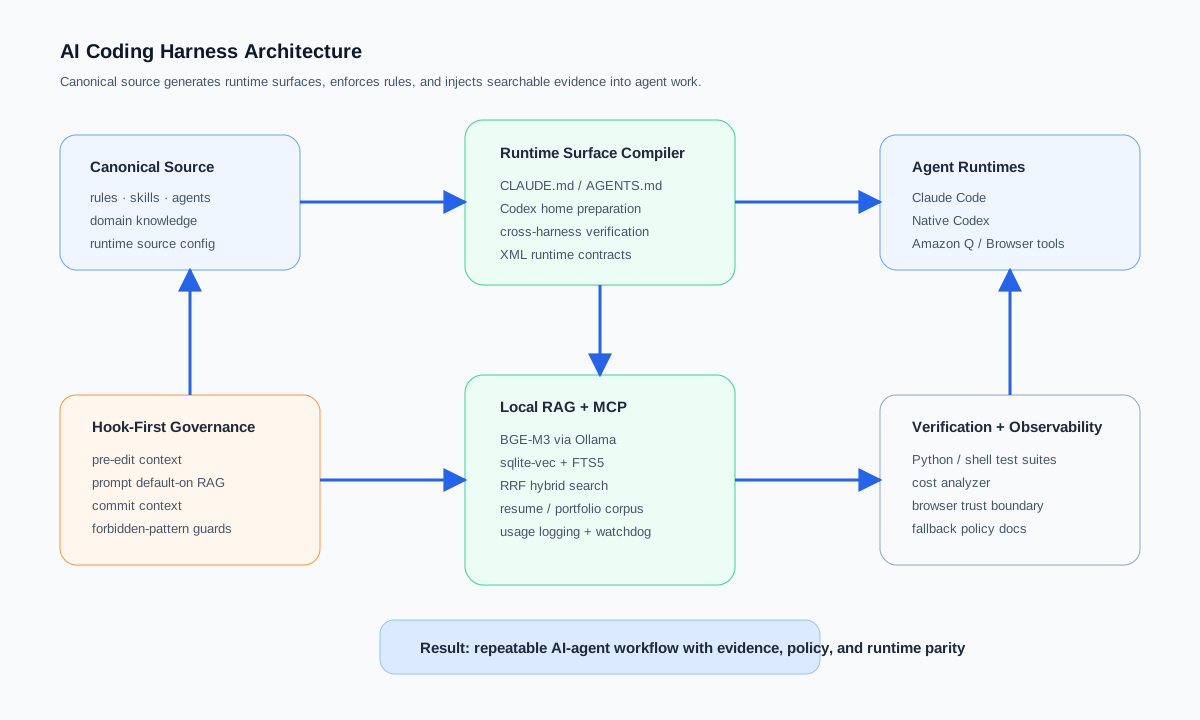
Made harness source the canonical source and generated runtime surfaces automatically, adding XML runtime contracts and cross-harness diff verification
Aligned generated docs and runtime contracts across kh/gp/gd harnesses
Growing markdown knowledge base forced agents to search context manually each time
Implemented sqlite-vec + FTS5 hybrid RAG, local BGE-M3 embeddings, RRF fusion, MCP search server, and automatic reindexing after markdown changes
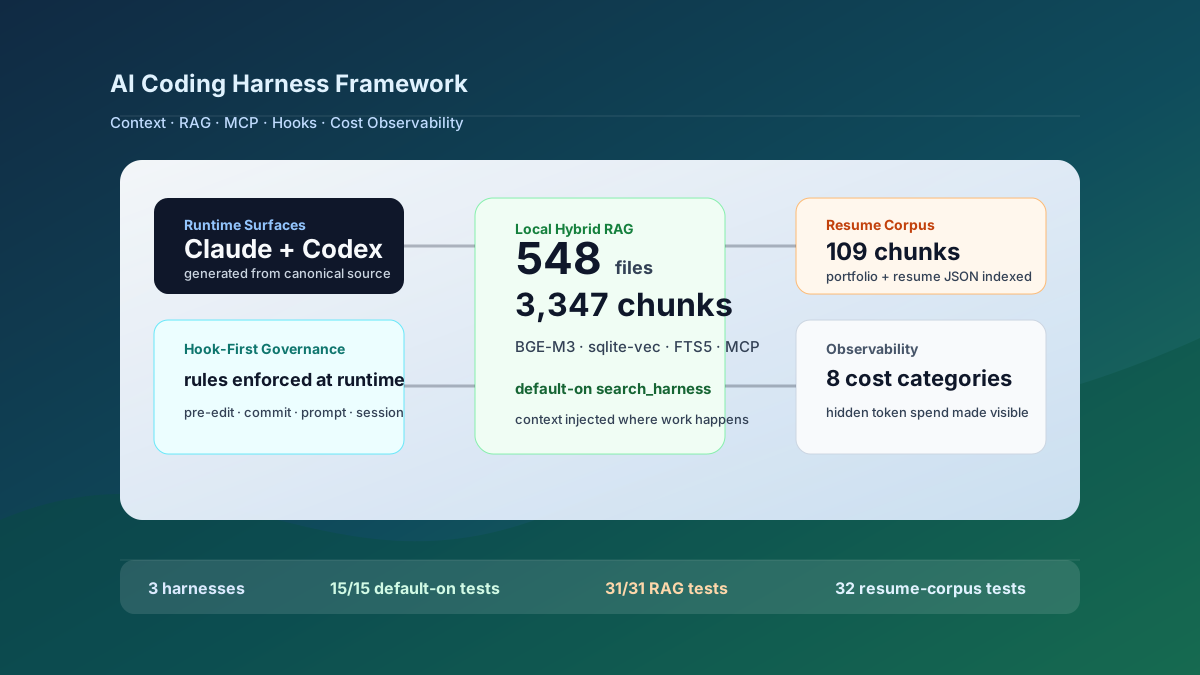
Indexed 548 files / 3,347 chunks / 20.7 MB, reached 0.7s warm queries, and hit top-2/3 on all 5 gold queries
RAG was an opt-in reference tool and was missed during real investigation/review prompts
Moved to a default UserPromptSubmit trigger, calling search_harness automatically for prompts of 12+ characters and porting it to gp/gd
Passed 15/15 default-on tests across 3 harnesses and hit the target in a real-prompt smoke test
Resume/portfolio JSON and JD-specific external feedback were disconnected, leaving job-specific improvement dependent on raw feedback alone
Connected resume/portfolio JSON chunkers, JD-custom PDF generation, Zighang recruitment-roast capture, and T1/T2/T3 triage templates
Classified Juvis NestJS as pass-range, Nexon settlement as 35% low-fit, and Hanwha Life AI Backend as 82% improve-to-pass through raw feedback → T1/T2/T3 triage → verification loops
Resume and JD customization evidence was scattered across session logs and work records, forcing manual re-selection and quantification of recent impact each time
Standardized the private work-data archive on schema v1.2 with outcome_metrics, classified Jira/session evidence by resumeProject, and connected it into the resume/portfolio/RAG curation path
Incrementally collected 279 work items, improved metric coverage 44%→50%, and established the work-data → resume-candidate selection → verification loop
Project Description
A personal harness designed to turn AI-assisted development from ad-hoc tool usage into a reproducible operating system. Runtime-specific settings are generated from source to reduce drift, while markdown, resume, and portfolio JSON are indexed through local-embedding RAG so evidence retrieval is attached to session start, prompt submission, edit, and commit events. Rules that documentation alone cannot enforce are backed by Git hooks and tests, and JD-custom PDF generation plus Zighang external feedback loops turn job-specific resume improvement into a raw feedback → T1/T2/T3 triage → verification → commit workflow.
Highlights
- Aligned 3 harnesses through automatic runtime-surface generation plus XML runtime contracts
- Indexed 548 files / 3,347 chunks with local BGE-M3 RAG and reached 0.7s warm queries
- Moved RAG to default-on search_harness calls for prompts of 12+ characters, passing 15/15 tests across 3 harnesses
- Integrated resume/portfolio JSON into the RAG corpus, indexing 109 chunks and passing 32 tests
- Documented browser/REPL runtime trust boundaries and fallback order, then reflected settings across 3 harnesses
- Added schema v1.2 + outcome_metrics evidence curation, incrementally collecting 279 work items and improving metric coverage 44%→50%
- Built JD-custom PDF + Zighang feedback loop; kept Juvis in pass range (92%→88%) and classified Nexon as 35% low-fit to avoid overfitting
- Hardened the Zighang recruitment-roast helper with main-scope result capture, Puppeteer element clicks, and upload-form guards to avoid sidebar-history false positives
Performance Metrics
| Performance Metrics | Before | After |
|---|---|---|
| RAG MVP Index | manual context search | 548 files / 3,347 chunks / 20.7 MB (0.7s warm query) |
| RAG Default-On Verification | opt-in trigger | 15/15 tests across 3 harnesses (prompt >=12 chars auto-search) |
| Resume RAG Corpus | 0 indexed chunks | 109 chunks (32 tests passed) |
| Work-data Evidence Archive | manual evidence curation / 44% metric coverage | 279 incremental work items / schema v1.2 (50% metric coverage) |
| JD Feedback Loop | manual JD feedback capture | JD PDF + Zighang recruitment-roast + T1/T2/T3 triage + form-start guard (Juvis pass range / Nexon low-fit / Hanwha 82% improve-to-pass) |
Tech Decisions
- ▶ Chose local BGE-M3 + sqlite-vec over cloud vector DBs to prioritize immediate reindexing after markdown changes and cost control
- ▶ Chose hook-first enforcement over doc-only rules to compensate for agents not reading policy documents at the moment of need
- ▶ Chose a runtime surface compiler over manual runtime settings to reduce generated-surface drift and automate 3-harness verification
- ▶ Chose default-on search over opt-in retrieval to reduce missed evidence during real investigation, review, and edit prompts
Lessons Learned
- • Learned that AI-assisted development productivity is reproducible only when runtime context, rule enforcement, evidence search, and cost observability share one operating path
- • Established that document-only rules remain reference material unless read at the moment of need, so critical rules should be enforced through hooks, tests, and compiler output
- • Confirmed that RAG must include trigger placement, index freshness, usage logging, and fallback paths, not just retrieval quality, to become part of an agent workflow
- • Learned that tools with different runtime features and trust boundaries need canonical source plus generation to reduce drift over long-term operation
- • Confirmed that separating work-data as an evidence layer for resume/JD/portfolio curation enables public-copy rewriting without exposing internal details